
Basking Ridge sits in a part of Somerset County where rolling terrain, clay-heavy soils, and seasonal nor'easters create a perfect recipe for water intrusion below grade. If you own a home here, you've probably heard a neighbor's horror story about a finished basement ruined after a single heavy storm. Preventing basement flooding in Basking Ridge requires understanding what makes this area uniquely challenging and then matching your defenses to those specific conditions. The good news: most water problems below grade are solvable with the right combination of drainage management and mechanical systems. The bad news: generic advice from national home improvement sites rarely accounts for the soil composition and water table behavior that Basking Ridge homeowners actually deal with. This guide focuses on the local factors that matter most and the sump pump strategies that keep basements dry year-round.
Understanding Local Drainage Challenges
Basking Ridge is part of the Passaic River watershed, and much of the township sits on glacial till: a dense mix of clay, silt, sand, and gravel deposited thousands of years ago. That geological history matters because clay-rich soils drain poorly. After a heavy rain, water doesn't percolate downward the way it would in sandy coastal areas. Instead, it moves laterally through the soil, building hydrostatic pressure against your foundation walls.
The local water table compounds the issue. Parts of Basking Ridge, particularly neighborhoods near the Great Swamp National Wildlife Refuge and lower-elevation areas along the Passaic River's tributaries, sit close to seasonally high water tables. During spring snowmelt or after consecutive storms in fall, the water table can rise to within a few feet of basement slab level. When that happens, water doesn't just push against walls: it pushes up through floor cracks and the cold joint where the slab meets the foundation.
Topography plays a role too. Many Basking Ridge homes were built on gently sloping lots that look well-graded until you watch where water actually flows during a downpour. Homes on Liberty Corner Road, Lyons Road, and in older subdivisions near the town center often have grading that has settled over decades, directing surface runoff toward the foundation rather than away from it. A simple slope correction (six inches of fall over the first ten feet from the foundation) can eliminate a surprising amount of water intrusion, but most homeowners never measure their grade.
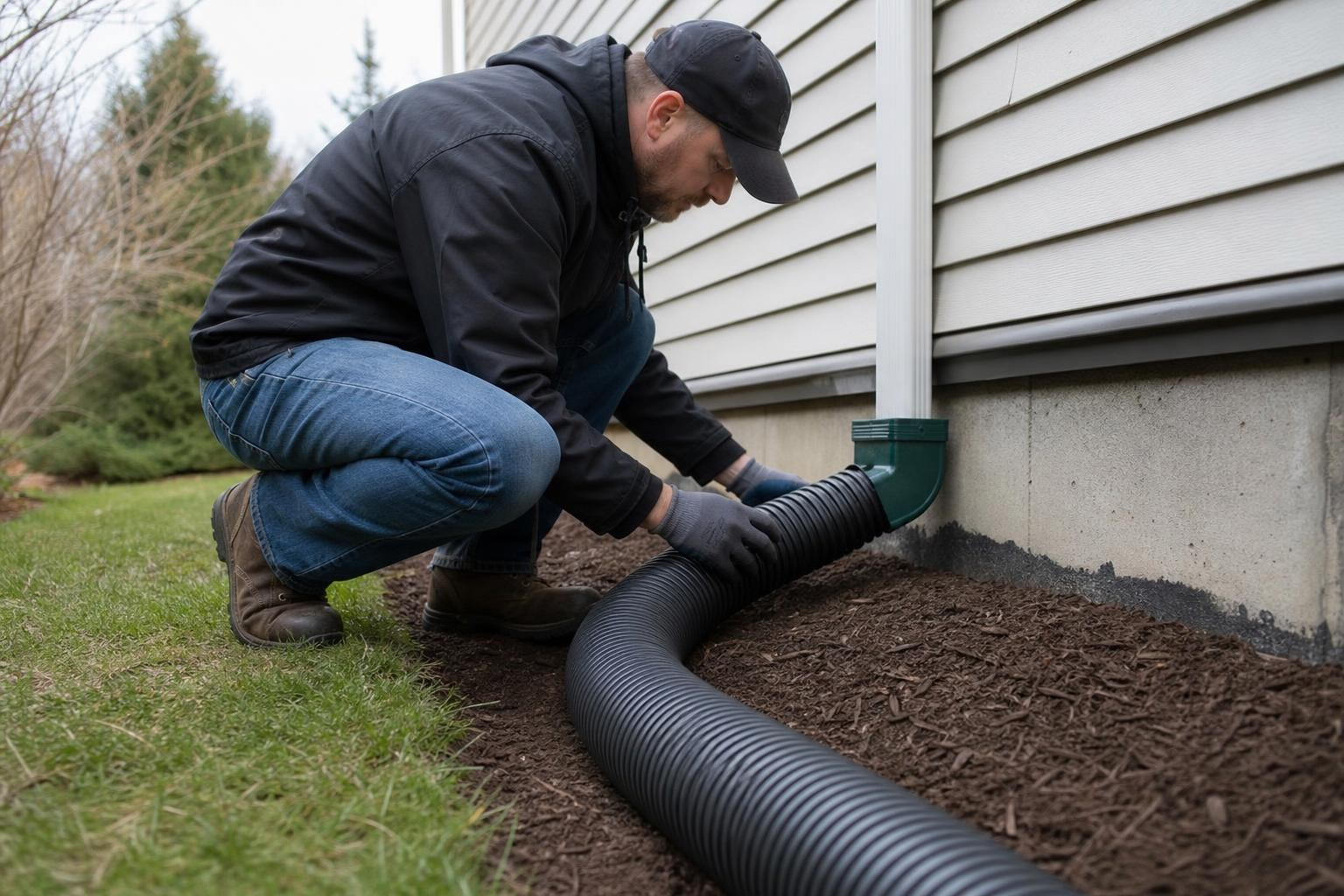
Gutter systems are another underappreciated factor. A typical 1,500-square-foot roof sheds roughly 900 gallons of water during a one-inch rainstorm. If your downspouts dump that water within two or three feet of the foundation, you're essentially pouring hundreds of gallons directly into the soil around your basement walls. In Basking Ridge's clay soils, that water doesn't dissipate quickly. It pools, saturates, and eventually finds its way through any crack or joint in the concrete.
Older homes in the area face additional challenges. Many homes built before the 1980s have exterior foundation waterproofing that has deteriorated or was minimal to begin with. Some rely on clay tile drain systems that clog with root intrusion and sediment over time. If your home was built in the 1960s or 1970s, there's a reasonable chance your original perimeter drain is partially or fully blocked.
Here's what a practical assessment looks like for a Basking Ridge homeowner:
- Walk your property during a heavy rain and note where water pools or flows toward the house
- Check that all downspouts extend at least four to six feet from the foundation, ideally draining to daylight or a dry well
- Look for efflorescence (white mineral deposits) on interior basement walls, which signals water migration through the concrete
- Inspect the cold joint at the base of your walls for dampness or active seepage
- Check your sump pit, if you have one, to see how frequently the pump cycles during and after storms
The combination of clay soils, seasonal water table fluctuations, aging drainage infrastructure, and grading issues makes Basking Ridge a place where passive waterproofing alone rarely gets the job done. Most homes here need an active water management system, which brings us to sump pumps.
Sump Pump Solutions
A sump pump is the last line of defense in a basement waterproofing system, and for most Basking Ridge homes, it's also the most critical one. The pump sits in a sump pit (also called a sump basin or crock), typically installed at the lowest point of the basement floor. An interior perimeter drain system, often called a French drain or drain tile, collects water that enters through the walls or floor and channels it to the pit. The pump then ejects that water away from the house.
The concept is simple, but execution matters enormously. A poorly sized pump, a cheap backup system, or a pit that's too small can fail exactly when you need protection most: during the kind of prolonged, heavy storms that hit central New Jersey several times a year.
Pump Selection
Choosing the right primary sump pump comes down to three factors: pumping capacity, switch type, and build quality.
Pumping capacity is measured in gallons per hour (GPH) at a given vertical lift height. Most residential sump pumps are rated at a specific GPH at an eight- or ten-foot head (the vertical distance water must travel from the pit to the discharge point). For a typical Basking Ridge home with moderate water intrusion, a pump rated at 3,000 to 4,000 GPH at ten feet of head is a solid starting point. Homes in lower-elevation areas or near the Great Swamp may need higher-capacity pumps, sometimes 5,000 GPH or more, especially if the pump cycles frequently during storms.
The float switch is the component that tells the pump when to turn on and off, and it's the most common point of failure. There are three main types:
- Tethered float switches work like a toilet float and are reliable in wide pits but can get stuck in narrow ones
- Vertical float switches move up and down on a rod and work better in tight spaces
- Electronic switches have no moving parts and tend to last longer, though they cost more upfront
For most homeowners, a vertical float or electronic switch offers the best reliability. Tethered floats are fine in a large pit but can jam against the pit wall or get tangled with the discharge pipe in the 18-inch-diameter pits common in older Basking Ridge homes.
Build quality is where you either save money now or spend it later. Cast iron and stainless steel housings dissipate heat better and last longer than thermoplastic models. A quality primary pump from a manufacturer like Zoeller, Liberty, or Wayne will typically run eight to twelve years before needing replacement. Budget models might last three to five. Given that a basement flood can easily cause $10,000 to $30,000 in damage to a finished space, spending $300 to $500 on a reliable primary pump is one of the better investments you can make.
Backup Power Systems
Here's the scenario that catches Basking Ridge homeowners off guard: a major storm knocks out power, your primary pump goes silent, and water starts rising in the pit. This isn't hypothetical. PSE&G outages during nor'easters and summer thunderstorms can last hours or even days. Your primary pump is useless without electricity, and those are precisely the conditions when water intrusion is at its worst.
You have two main backup options: battery backup pumps and water-powered backup pumps.
Battery backup systems use a dedicated pump (separate from your primary) powered by a marine deep-cycle battery or a set of batteries. When the power goes out, the backup pump activates automatically. A good battery backup system can pump 2,000 to 3,000 gallons on a full charge, which typically provides eight to twelve hours of intermittent pumping. For storms that knock out power for a day or more, battery capacity becomes a real concern. Some newer systems use lithium-ion batteries that hold charge longer and recharge faster when power returns.
Water-powered backup pumps use municipal water pressure to create suction and pump water out of the pit. They require no electricity and never run out of "fuel" as long as your municipal water supply is active. The downside: they use roughly one gallon of municipal water for every two gallons they pump out, which increases your water bill during extended use. They also require sufficient water pressure (typically 40 PSI or higher) to function effectively. For Basking Ridge homes on NJ American Water's system, pressure is generally adequate, but homes on well water can't use this option.
A belt-and-suspenders approach that many local waterproofing contractors recommend: install a quality primary pump, add a battery backup pump, and consider a whole-house generator if your home is in a flood-prone area. A standby generator (natural gas or propane) keeps your primary pump running indefinitely during outages and also powers your HVAC, refrigerator, and other essentials. The installed cost for a standby generator runs $8,000 to $15,000 in the Basking Ridge area, but for homes with finished basements valued at $50,000 or more, the math works out quickly.
One more detail that gets overlooked: test your sump pump system quarterly. Pour five gallons of water into the pit and confirm the pump activates, runs, and shuts off properly. Check the battery on your backup system (most units have a test button or indicator light). And inspect the discharge line outside to make sure it's clear of debris, ice, or animal nests. A pump that worked fine last spring might have a stuck float or a frozen discharge line when you actually need it.
Protecting Your Basking Ridge Home for the Long Term
Basement flooding prevention for Basking Ridge homeowners isn't a one-time project. It's an ongoing commitment to maintaining drainage, monitoring your mechanical systems, and adapting as conditions change. The homes that stay dry are the ones where owners check their grading annually, keep gutters clean and extended, test their sump systems regularly, and replace aging components before they fail.
If your basement has never flooded, don't assume it never will. Soil conditions shift, water tables fluctuate, and the storms hitting central New Jersey have been delivering more rainfall per event than they did twenty years ago. A proactive approach costs a fraction of what emergency remediation runs after a flood.
Start with the basics: grade your lot properly, manage your roof runoff, and install or upgrade your sump pump system with a reliable backup. Those three steps alone prevent the vast majority of basement water problems in this area. Your basement is too valuable, and too expensive to repair, to leave unprotected
Recent Comments